The idea for this post really started with this poll:
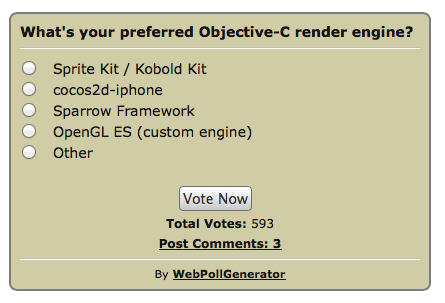
I’ll present the results further down. Not wanting to spoil it before you made your choice.
This poll was just a quick test for a free web poll service. Well that and being curious how the major 3 Objective-C render engines compared against each other.
Since I added a “Other” choice and some users took it, I started to wonder what the “Other” choices might be.
I mean besides cocos2d-iphone, Sprite Kit, Sparrow and OpenGL ES, what choices could there really be? Have I perhaps not noticed the next big thing in Objective-C render engines?
Spoiler: I didn’t.
The Poll Results (as of Nov 28th 2013)
iOS 7 and thus Sprite Kit has been available for just over 2 months.
My expectation was that being so new and despite coming from Apple and developers usually slow to change their preferences, cocos2d-iphone would likely come out on top. At best it would have a head-to-head with Sprite Kit.
The actual result really surprised me: Continue reading »
With yesterday’s release of iOS 7 and hence Sprite Kit, many cocos2d developers will face this question sooner or later: switch to Sprite Kit or Kobold Kit or stick with cocos2d-iphone or perhaps move on to cocos2d-x?
I’ll give you some guidance and things to consider …
Sprite Kit / Kobold Kit
Sprite Kit made quite the splash. There are new tutorials coming out by the minute. Two books will be available within days after release. Several high profile tutorial & starterkit authors have jumped on the bandwagon. Tool developers are hard at work adding Sprite Kit support. Instructors are already offering new mobile game development courses based on Sprite Kit. Heck I even started a new game engine based on Sprite Kit: Kobold Kit.
With almost everyone jumping ship, it seems a safe bet to jump ship, too. You’re guaranteed to get excellent documentation from Apple, plus a stability of the framework until at least iOS 7.1 and even then Apple is known to carry on supporting deprecated methods for several versions. It’s easy to learn, and once learned you won’t be thrown off guard by new releases. And the developer community will soon surpass that of cocos2d-iphone. Continue reading »
I am so very happy to … no, actually I’m relieved Kobold2D is working fine again with the latest Xcode 4.6, including iOS 6 autorotation fixes and the FIX_CATEGORY_BUG issue. Being happy is reserved for whenever I’ve added something nice to KoboldTouch.
Of course I updated cocos2d-iphone to version 2.1-rc0a (on first sight that version looks like being encoded in hexadecimal). Which meant I also had to update cocos2d-iphone-extension to whatever is the current development version - which must be somewhat above 0.21 but that’s hard to tell because there’s no reference of a version number anywhere.
Also updated Chipmunk (6.1.2) and obviously that had to be followed by updating Chimpunk (oh there it is again - my favorite typo today) SpaceManager v0.2.01.
Lastly Admob was playing hard to catch. And it has grown awfully huge, comes with several of Google’s other SDKs as well. Given the dwindling interest in ads by game developers I just pulled the plug and removed AdMob. You can still add it back in to your project according to Google’s instructions though.
That said, here’s the download link for Kobold2D v2.1. Here’s the link to the Release Notes.
I’ll make another update when cocos2d 2.1 is final. The next version is dated for “March” according to the Changelog, but that’s going to be another release candidate. I didn’t want to hold off on updating Kobold2D for the cocos2d 2.1 final version.
PS: There won’t be anymore updates to the Kobold2D v1.x branch.
When you embark on a project, the first thing a developer ought to do is to run some basic math. Especially if you already have some specs regarding the number and sizes of assets. Because otherwise you may end up trying hard to work around a memory related issue which perhaps even modern desktop computers would struggle with.
So today, I’ll do some math for you, the things you should consider before starting a project or adding one more of those big new shiny features to your app. Kind of like an addendum to my popular article about memory optimization and reducing bundle size.
How much wood texture would a woodchuck choke on if a woodchuck could choke on wood textures?
A texture is an in-memory representation of an image made up of individual pixels. Each pixel uses a certain amount of memory to represent its color. A texture’s memory size is therefore simply the product of width * height * sizeof(color).
Before I go any further, I like to stress it again: the size of an image file is much smaller than the size of the texture generated from the image. Don’t use image file sizes to make memory usage estimations.
Most common are 32-Bit and 16-Bit textures which use 4 and 2 Bytes respectively per pixel. A 4096×4096 image with 32-Bit color depth therefore uses 64 MB memory. Let that sink in for a moment …
At 16-Bit it only uses half of that, though without color dithering (TexturePacker does this for you) this might not look too good depending on the image.
This is pretty much what you’re stuck with unless you export textures as .pvr.ccz. Not only does this format load tremendously faster than PNG (not to speak of JPG which are unbearably slow to load in cocos2d), the .pvr.ccz format also reduces the texture memory size because the texture can stay compressed in memory.
It’s extremely difficult to estimate how much smaller a PVR texture’s memory footprint will be without actually giving it a try. But you can expect anywhere between 10% to 50% reduction.
To the non-power-of-two!
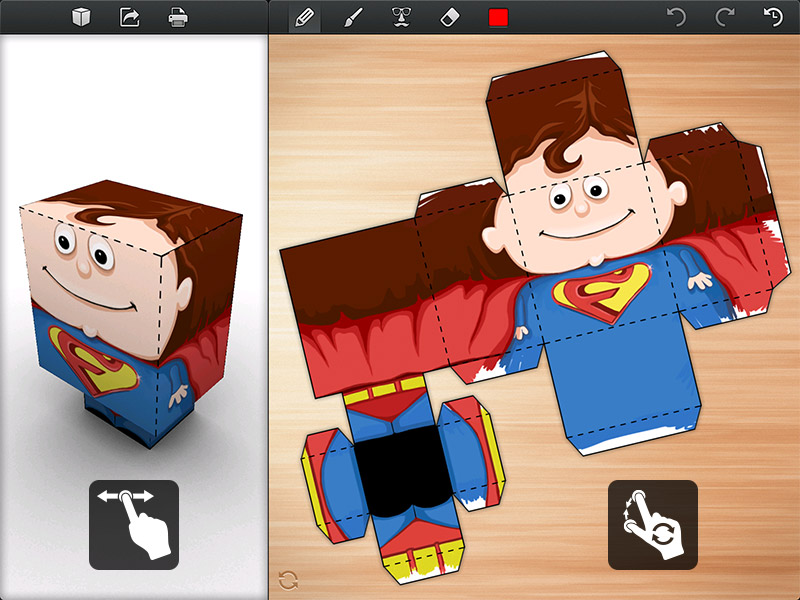 There hasn’t been a new Cocos2D Podcast in over 4 months.
It was about time Mohammad Azam and I recorded another one.
This time our guest was Krzysztof Zabłocki, developer of the Foldify app and contributor to cocos2d-iphone.
Among other improvements Krzysztof added stencil buffering to CCRenderTexture.
Interviews with Mobile Game Engine Developers
The Mobile Game Engines eBook is now available!
One of the interviews is with me, about Kobold2D. KoboldTouch was at the time no more than an idea.
Jason Brownlee gave me permission to share the full interview with me (PDF, 18 pages). Go on, read it!
There are of course plenty more reknown game engine developer interviews in this book. Here’s the full list of interviewees: Continue reading »
I’m really happy and excited that YETIPIPI was released today in the iOS App Store! 
UPDATE: currently only available in german App Store due to delayed english localization.
Go grab it for $.99 (€.89) try it out and give it it’s (hopefully) deserved 5-Star review.
What’s the game about?
YETIPIPI was a contract project in collaboration with Doubleplus Digital Media Entertainment for Joscha Sauer. Joscha is one of germany’s most popular cartoonists and the mastermind behind the Nichtlustig cartoons (some of his cartoons are also available in english).
The game is inspired by one particularly famous comic strip, where a Yeti pees in a circle, leaving him (or in this case both) stranded in an unfortunate situation.

To survive, our Yeti must drink so he can pee the ice floes floating about in ever smaller pieces. You control the Yeti with the accelerometer to collect items, evade ice floes and to aim your stream of urine. Continue reading »
I completed KoboldTouch v6.0 today. Time to let you know what changed and what will be coming for v6.1.
KoboldTouch v6.0 - Foundation
This version mostly included changes moving from Kobold2D to KoboldTouch. I had already removed superfluous libraries, so KT now only includes Cocos2D with CocosDenshion and the Cocos2D extensions project, the Kobold2D and KoboldTouch source code obviously and Box2D.
But there’s more of course: